Tibet Master,Tibet Tours,Tibet Travel
about Tibet Travel Permit (chinese name: 外国人进藏许可证)
1. only foreign passport holders and visitors from Taiwan to Tibet need to apply for a visa, citizens of the mainland and Hong Kong and Macao residents do not need to apply.
2. to apply for visa to Tibet: You can simply copy your passport and occupation to your travel agents can apply for a visa to Tibet.
Good for Tibet visa, travel agencies in Tibet will give you a confirmation, and only with Tibet in order to confirm the purchase of books and bus tickets and travel tours.
If the foreign guests and compatriots in Taiwan to participate in dream trip to Tibet tour could be a copy of your passport 0086-891-6820909 fax to us, or can give us email: tibet@live.com , we can apply for your Tibet procedures.
People can go to the border areas of Tibet Tibet border area to apply for approval of letter of travel permits, generally by Tibet travel agent. General needs of visitors to Tibet for a tourist visa, that is, we often say that the L visa, business visa if it is also Tibet, but some trouble. Be noted, however, is not allowed foreign journalists into Tibet visa, please note that foreign friends in the item.
Tibet Travel Permit Infomations
Tibet Travel Permits (or Tibet visa) are the necessary documents required for a tour to Tibet in addition to Chinese visa. Tibet Travel Permits vary according to the places that travelers plan to visit, but the most basic one is the permit issued by Tibet Tourism Bureau. It is required as a must entry pass to Tibet for every foreign traveler.
Due to Tibet's unique ethnic traditions, cultural heritage, tourist service facilities, reception capacity, ecological protection needs and traffic situation, the National Tourism Administration prescribed that foreign tourists, Taiwan and overseas Chinese tourists (except for Hong Kong and Macao residents holding Chinese passports or return certificates) have to get a Tibet Travel Permit before they are allowed to enter Tibet. All tourists can get it through a travel agency except for diplomats, journalists and government officials. They have to go through the Tibet Foreign Affairs Office.
Please keep in mind that foreign tourists are generally required to have four kinds of documents to travel in Tibet.
Chinese Visa
As Tibet is under the jurisdiction of China, tourist will need to obtain the first document, Chinese Visa, for the purpose of entering China. Tourists can apply for it in a Chinese Embassy overseas or in Hong Kong.
Chinese Visa

A Sample of Chinese Visa
Tibet Travel Permit
The Tibet Travel Permit is issued by Tibet Tourism Bureau (TTB). It is also called Tibet visa, for the purpose of entering Tibet.
Tibet Travel Permit

A Sample of Tibet Entry Permit
Travelers need to have Tibet Travel Permit to enter into Lhasa or any other parts of the Tibetan Autonomous Region. It is obtained through tour operators for most tourists. When you take a flight or train to Lhasa, you will be asked to show this permit during check-in. Furthermore, the permit is also needed by groups traveling by road. But this will be arranged by the travel agency organizing the trip.
Important Issues About Tibet Travel Permit
1. Only after having your Tibet Travel Permit can a travel agency buy air tickets for you. You can then pass airport check-in.
2. Even if you have the Tibet Travel Permit, you are not allowed to travel anywhere outside of Lhasa city. If you want to get out of Lhasa, you have to apply for another permit, Aliens' Travel Permit.
3. Generally speaking, it takes three working days to get the Tibet Travel Permit if you submit all the necessary documents on time.
Read More
Tibet Visa for Travel
Tibet visa for Indian passport
Aliens' Travel Permit
The Alien’s Travel Permit is issued by the Public Security Bureau. It is required when tourists are planning to travel to the 'unopened' areas of Tibet, like Mount Everest Base Camp in Shigatse, Samye Monastery in Tsedang.
Aliens' Travel Permit
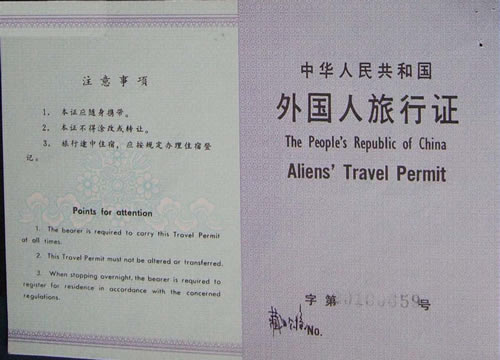
A Sample of Aliens' Travel Permit
Aliens' Travel Permit is required to visit 'unopened' areas. It is issued by the police (Public Security Bureau, "PSB"). Usually, you can apply for it once you arrive at Lhasa. For tour groups, our guide will ask you for the passport and Tibet Travel Permit, which they will submit to the Foreign Affairs Division of the PSB for the Aliens’ Permit. It normally takes several hours and the cost is 50 CNY per person. If you travel alone, you need to join local tours to 'unopened' areas, and the local travel agencies will arrange the PSB for you as well. Pay attention, no travel agency can provide 'Alien’s Travel permit-only' service.
Notice: If you want to do a Tibet overland tour from Yunnan, Sichuan, Qinghai or Xinjiang province to Tibet, you must got the PSB permit before your tour starts.
Which parts of Tibet are listed as the closed areas?
At present, you have to apply for a Alien’s Travel permit if you are planning to visit the following places:
Tsedang: Samye Monastery, Tomb of Tibetan King, Trundruk Monastery, Yumbulakhang
Shigatse: Sakya Monastery, Mt. Everest, Rongbuk Monastery
Gyangtse: Pelkor Chode Monastery & Kubum Stupa
Ngari Region: Mt. Kailash, Lake Manasarovar, Tsaparang, Years, etc.
Nyingchi Region: Basum-tso, Pomi, Rawo-tso, etc.
Chamdo Region: Chamdo, Riwoche, Tengchen, etc.
Military Area Entry Permit
The military area entry permit is required if tourists are planning to travel to some military sensitive areas in Tibet. Like Mount Kailash in Ali, Rowok Lake in Chamdo.
Military Area Entry Permit

A sample of Military Area Entry Permit.
Sensitive borders such as Mt. Kailash and eastern Tibet not only require a Military Area Entry Permit, but also a Foreign Affairs Permit. For Tholing and Tsaparang in western Tibet, you will also need a permit from the local Cultural Antiquities Department. All these will be arranged by our travel agency one month before you enter Tibet. The Military Area Entry Permit is issued by the military affairs office while the Foreign Affairs Permit is issued by the Foreign affairs office in Lhasa. It normally takes 10-15 working days to get them all.
Tibet Permit Application Procedure
1. Email us the photo copy of your passport and Chinese Visa at least 20 days before your Tibet tour starts.
There are three main types of Chinese Visa, “L”,”F”,“Z”, including other types for studying, travelling and working.
Please refer to Apply for Tibet Visa to understand what Travel documents you need to prepare.
Note: Any Visa issued by associations like APEC is not equal to Chinese Visa for Tibet Travel Permit application.
2. If you work or live in China or visit China for business purpose, you will need to offer a certificate to prove your purpose for visiting China.
|
Confirmation We herewith confirm that your full name , Passport Number, is working at your company name since the date you join in this company to work as your position .
(for visiting) Visit our company for your purpose , from the date you star visiting to the date you end visiting.If you have any question concerning with your full name, please feel free to contact the telephone number and fax number of your company
Company Name:
Company Seal:
Date:
|
2. Your Tibet Travel Permit will be issued within 2-5 working days after we pass your documents to Tibet Tourism Bureau.
The Tibet Travel Permit will be posted to the city from which you depart to Tibet. Please let us know the address and telephone number of your hotel in that city 15 days before you arrive in China. If we want you to pick up the documents at our branch office in that city, we will mention it in the contract.
3. Travelers need to offer unfeigned, effective and related credential, license or certificate through which CITS Tibet Travel Org will apply for necessary permits.
Once any counterfeit credential, license or certificate from travelers is confirmed, CITS Tibet Travel Org reserves the right to cancel the corresponding trip, without any refund. Necessary compensation from travelers also occurs when any counterfeit made by the travelers induces loss to CITS Tibet Travel Org.
Please pay attention: Tibet occasionally sees political tension and social unrest. When there are important political events or any indication of such political or social unrest, the government may not issue Tibet Travel Permits. Although the conflicts are defused day by day, it is still a problem out of our control. Therefore, we cannot guarantee that you will get the Tibet Travel Permit under those circumstances. Moreover, we cannot predict when it will happen. Please do understand and take it into consideration when planning your trip to Tibet. However, it is not necessary to worry too much because it rarely happens. And any unofficial information you find on the Internet or hear from other people, even from travel agencies, can be considered as rumor. Please do not believe it unless you get an announcement from the government.
Read More:
Tibet Visa Application Guidelines Update
Tibet Visa from Nepal
Special Notice about the Nepal Earthquake
As the catastrophic earthquake resulted in widespread damage and loss of life across Nepal, the access to Nyalam County, the Sino-Nepal border, was also temporarily shut down and so was the entire region of Shigatse for both the safety concerns for the tourists and the assistance of the Nepalese disaster relief and rescue efforts.
In addition, the application and issue of Tibet Travel Permit was also affected due to the natural disaster. Currently, Tibet Travel Bureau suspended temporarily the issue of Tibet Travel Permit of Ali and Shigatse region and the suspension was expected to last at least 10-15 days, or even longer.
However, those prime attractions not affected by the aftershocks of earthquake in Tibet, remained safe to travel, places like Lhasa, Namtso Lake, Yalongzangbu river, dozens of monasteries, etc
2016 Tibet Travel Permit or Tibet Visa Information Updated on Jan 7th, 2016
Currently it is winter in Tibet and many people thought it is freezing cold and not a good time to travel Tibet, but in the reality, it is not freezing cold as you thought, even though today's temperature in Lhasa is 9 to -15 degree celcius, but it is sunny in the day and there are crowds of local Tibetan pilgrims all around, and not many tourist crowds, so actually Tibet winter tour is the best way to learn and experience authentic Tibet, and the most important is there is no permit restriction at all and the whole Tibet travel permit process is shorten to 7 days, couple of days ago, Tibet tourism bureau had announced that Tibet travel permit won't have any restriction untill Feb 20th, then from Feb 20th to end of March, the permit would be closed for one month. Since from 2008, the tibet travel permit is closed for every March, but it will reopen again from end of March, so if you planning the Tibet tour from April, then you can start book a Tibet tour and will get the permit from April 1st onward. If you are still planning your Tibet tour, then please check our Tibet